02 / Field guide
Quick identification
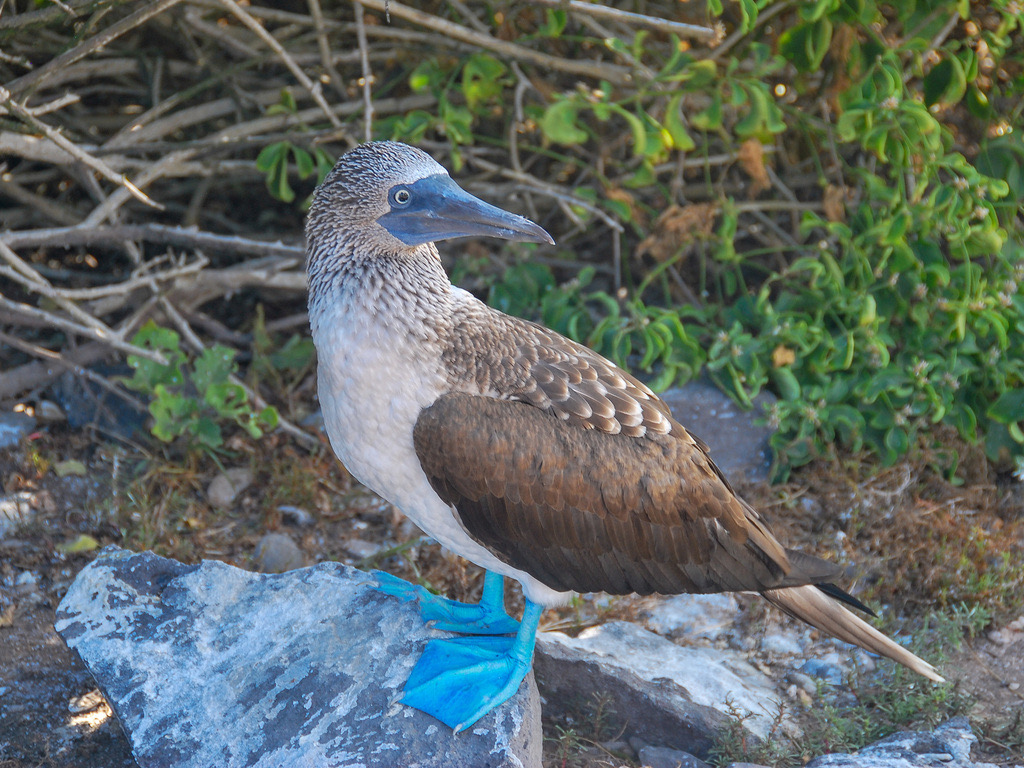
Adults combine bright blue feet, a long pointed bill, pale head and neck, brown wings and a white belly. Juveniles have dull feet and browner plumage.
Confirm the whole animal and context rather than a single color patch. Age, sex, molt, distance and light can all change apparent pattern.
03 / Field guide
Range & habitat
Breeds from the Gulf of California south to Peru and the Galápagos; incursions occasionally bring birds to coastal and inland southern California waters.
Marine waters, rocky islands, bays and productive nearshore zones where schooling fish concentrate.
Use current observations to confirm broad seasonal presence, then check access with the land manager. A mapped record is not an invitation onto private or restricted ground.
04 / Field guide
Behavior
Feeds by plunge-diving, sometimes from substantial height, and may form groups over fish. On land it walks upright and can appear heavy-bodied.
Behavior is useful evidence only when combined with structure and plumage or body pattern. Give the animal enough space to continue feeding, resting or traveling normally.
05 / Field guide
How to find it
Check recent reports before a targeted search, then scan jetties, offshore rocks and feeding flocks from public access. A distant brown-and-white sulid must show structure and foot color before confident identification.
Keep the search habitat-led. Recent reports can focus effort, but they should not encourage crowding, trespass or repeated disturbance.
06 / Field guide
Similar species
Brown Booby is darker overall with a sharp brown-white boundary; Northern Gannet is larger, paler and lacks blue feet.
When a view is incomplete, record the characters you actually saw and leave room for uncertainty. Photographs, date, location and habitat make later review possible.
07 / Field guide
Photography in the field
For plunge dives use 1/2500–1/4000 second, a wider initial field of view and high-speed drive. Keep distance from loafing birds and seabird colonies.
Settings are starting points. Subject welfare, legal access and a safe working distance take priority over focal length or frame-filling composition.
Research standard
Sources & field references
- Cornell Lab — Blue-footed Booby
- eBird — Blue-footed Booby
- IUCN Red List — Sula nebouxii
- iNaturalist source photograph taxon — Sula nebouxii excisa (subspecies)
Access, fees, closures and regulations can change quickly. Confirm practical details with the managing agency before travel.