02 / Field guide
Quick identification
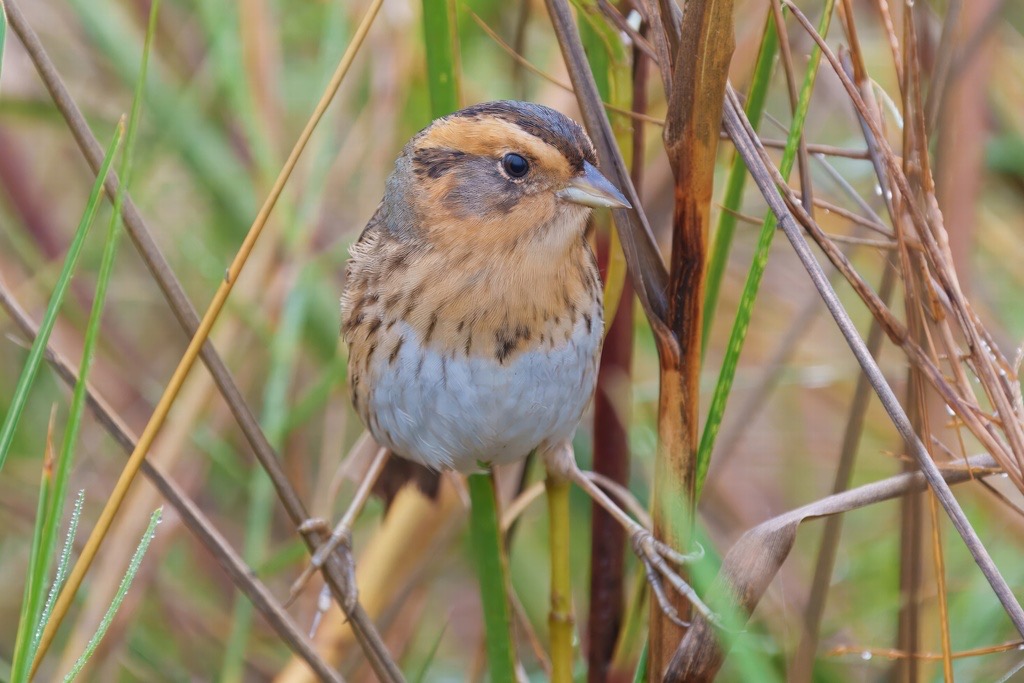
Small and short-tailed with a gray crown stripe, orange face and breast, and fine dark breast streaks. Some populations look brighter and more sharply patterned than others.
Confirm the whole animal and context rather than a single color patch. Age, sex, molt, distance and light can all change apparent pattern.
03 / Field guide
Range & habitat
Breeds in the north-central interior, Hudson Bay region and northeastern Atlantic marshes; winters along the Atlantic and Gulf coasts.
Fresh and brackish marshes with dense sedges, cordgrass and wet meadow vegetation.
Use current observations to confirm broad seasonal presence, then check access with the land manager. A mapped record is not an invitation onto private or restricted ground.
04 / Field guide
Behavior
Usually stays low in marsh vegetation, running between stems and making brief flights. Males give a thin, hissing song from exposed grass tops.
Behavior is useful evidence only when combined with structure and plumage or body pattern. Give the animal enough space to continue feeding, resting or traveling normally.
05 / Field guide
How to find it
Time searches to safe tides and seasonal occurrence. Listen from established dikes or boardwalks and wait for the bird to rise rather than pushing through marsh vegetation.
Keep the search habitat-led. Recent reports can focus effort, but they should not encourage crowding, trespass or repeated disturbance.
06 / Field guide
Similar species
Saltmarsh Sparrow tends to have crisper, darker streaking and a different face pattern; LeConte’s Sparrow has a stronger white crown stripe and favors different migration habitat.
When a view is incomplete, record the characters you actually saw and leave room for uncertainty. Photographs, date, location and habitat make later review possible.
07 / Field guide
Photography in the field
Use 1/1000 second or faster for brief pop-ups, continuous focus and a single clear gap in the grass. Never use tide or playback to trap birds against an observer.
Settings are starting points. Subject welfare, legal access and a safe working distance take priority over focal length or frame-filling composition.
Research standard
Sources & field references
- Cornell Lab — Nelson’s Sparrow
- eBird — Nelson’s Sparrow
- Audubon Field Guide — Nelson’s Sparrow
- iNaturalist source photograph taxon — Ammospiza nelsoni
Access, fees, closures and regulations can change quickly. Confirm practical details with the managing agency before travel.