02 / Field guide
Quick identification
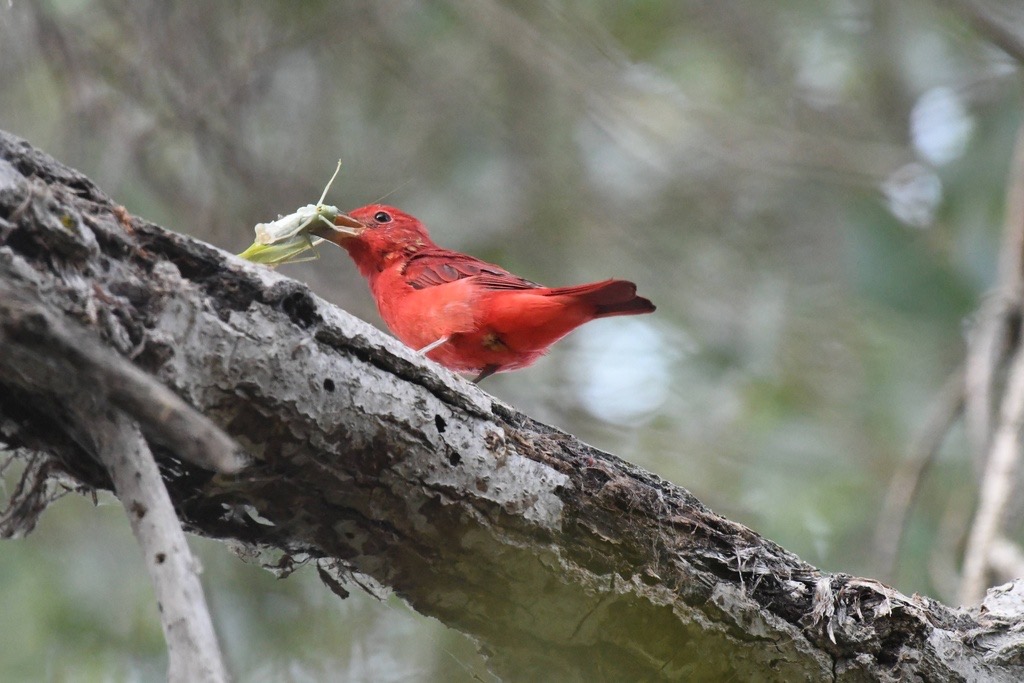
Adult males are entirely rosy red; females are mustard yellow to olive. Both have a thick pale bill and unmarked face compared with similar red or yellow songbirds.
Confirm the whole animal and context rather than a single color patch. Age, sex, molt, distance and light can all change apparent pattern.
03 / Field guide
Range & habitat
Breeds across much of the southern and eastern United States and locally in the Southwest; winters from Mexico through northern South America.
Open deciduous forest, riparian woodland, pine-oak and mature shade trees, varying across its broad breeding range.
Use current observations to confirm broad seasonal presence, then check access with the land manager. A mapped record is not an invitation onto private or restricted ground.
04 / Field guide
Behavior
Often forages high and deliberately, taking insects and fruit. It is especially known for catching bees and wasps and removing stingers before eating them.
Behavior is useful evidence only when combined with structure and plumage or body pattern. Give the animal enough space to continue feeding, resting or traveling normally.
05 / Field guide
How to find it
Listen for the repeated pi-tuck call and robin-like song, then scan the mid- and upper canopy. In the Southwest, riparian cottonwoods are productive migration and breeding habitat.
Keep the search habitat-led. Recent reports can focus effort, but they should not encourage crowding, trespass or repeated disturbance.
06 / Field guide
Similar species
Hepatic Tanager is darker with a gray bill and cheek; Scarlet Tanager male has black wings and tail; female Western Tanager has wing bars.
When a view is incomplete, record the characters you actually saw and leave room for uncertainty. Photographs, date, location and habitat make later review possible.
07 / Field guide
Photography in the field
Expose carefully for saturated red plumage and wait near a natural canopy opening. A slower, controlled burst often yields better wing and bill positions than continuous firing.
Settings are starting points. Subject welfare, legal access and a safe working distance take priority over focal length or frame-filling composition.
Research standard
Sources & field references
- Cornell Lab — Summer Tanager
- Audubon Field Guide — Summer Tanager
- eBird — Summer Tanager
- iNaturalist source photograph taxon — Piranga rubra
Access, fees, closures and regulations can change quickly. Confirm practical details with the managing agency before travel.