02 / Field guide
Identification
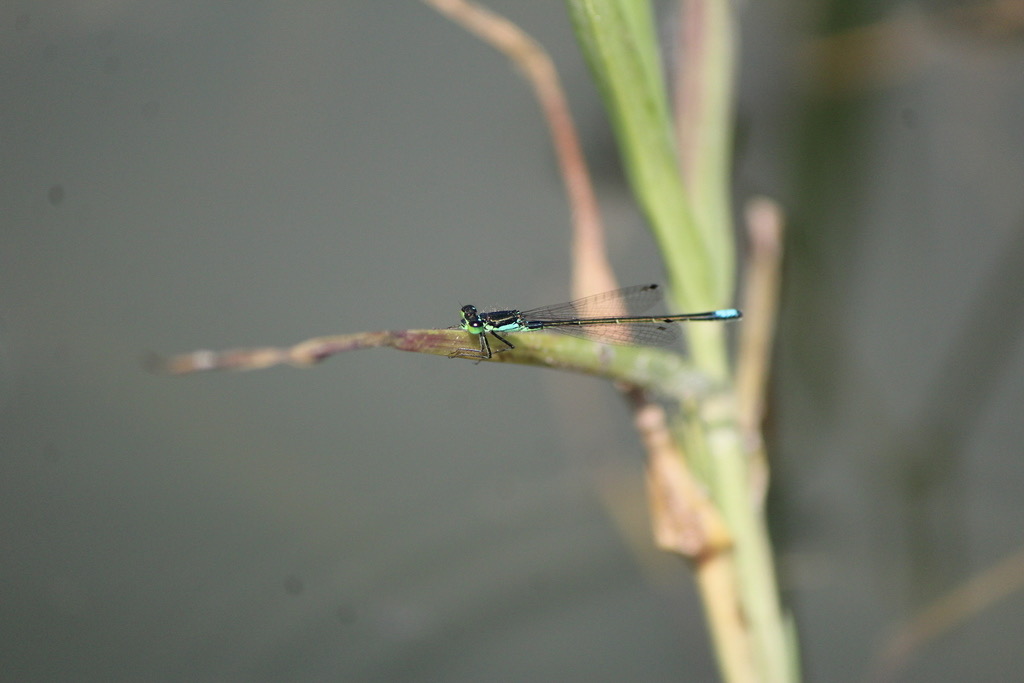
Males have a mostly black face, green thorax and a blue terminal abdominal patch; females vary with age and may be orange, green or dark.
The adult male's black face is a critical clue alongside a green thorax and blue at the abdominal tip. Females change from orange through green or dark forms, so female color by itself cannot separate this species from Pacific, Plains or Mexican Forktails.
03 / Field guide
Documented range
Black-fronted Forktail ranges from Oregon, Utah and Kansas south to Guatemala. That broad boundary includes western, interior and southern populations rather than a California-only distribution.
It is documented across much of the Southwest, with especially substantial California and Arizona records and more local occurrence inland. Colorado reports are sparse enough to merit a complete photographic record.
04 / Field guide
Habitat & flight period
Ponds, marsh edges, quiet stream margins and small constructed wetlands with fine emergent vegetation.
Flights can be lengthy in mild lowlands and are compressed into summer at cooler inland or elevated sites.
05 / Field guide
Finding strategy
Look below knee height in sedges and grasses. Forktails often remain close to shore and can be overlooked when attention stays on open water.
Search below knee height in sedges, rushes and fine grass around ponds or quiet stream margins. Obtain a face-on view before the insect shifts position; the feature named by the species is easily lost in a purely lateral photograph.
06 / Field guide
Similar species
Pacific, Plains and Mexican Forktails overlap in parts of the range. Face color, thoracic stripes and abdominal-tip pattern all matter.
07 / Field guide
Photography in the field
Approach from the water side only where footing and habitat allow; otherwise find a clear bank opening and let the insect return to a favored stem.
Protect the water edge, keep a working distance, and leave the insect and its perch as found.
Research standard
Sources & field references
- iNaturalist taxon and research observations — Ischnura denticollis
- Odonata Central — North American records, taxonomy and flight data
- Dragonfly Society of the Americas — 2024 North American checklist
Access, fees, closures and regulations can change quickly. Confirm practical details with the managing agency before travel.