02 / Field guide
Start with water
Odonata are organized by water before they are organized by state lines. Flowing-water dancers and rubyspots occupy a different working landscape from pond bluets, marsh forktails and seep specialists. Note current, depth, substrate, emergent vegetation, shade and whether the water is permanent before opening a field guide.
The Southwest is not uniformly hot or dry. A low Sonoran pond can support a long flight season while a Colorado mountain marsh may produce adults for only a short summer interval. Springs and isolated seeps can hold highly localized populations; those small wet places are also the easiest to damage.
- Rivers and rocky streams — dancers, rubyspots and territorial bank perches
- Ponds and marshes — bluets, forktails, firetails and emergent-stem activity
- Springs and seeps — localized specialists and fragile saturated ground
- Mountain lakes and boggy ponds — northern species at the southern edge of range
03 / Field guide
Dragonfly or damselfly?
Most damselflies are slender, with separated eyes and wings commonly held together or partly spread at rest. Most dragonflies are heavier, have eyes that meet or nearly meet, and rest with wings open. Those rules describe the groups, not every pose.
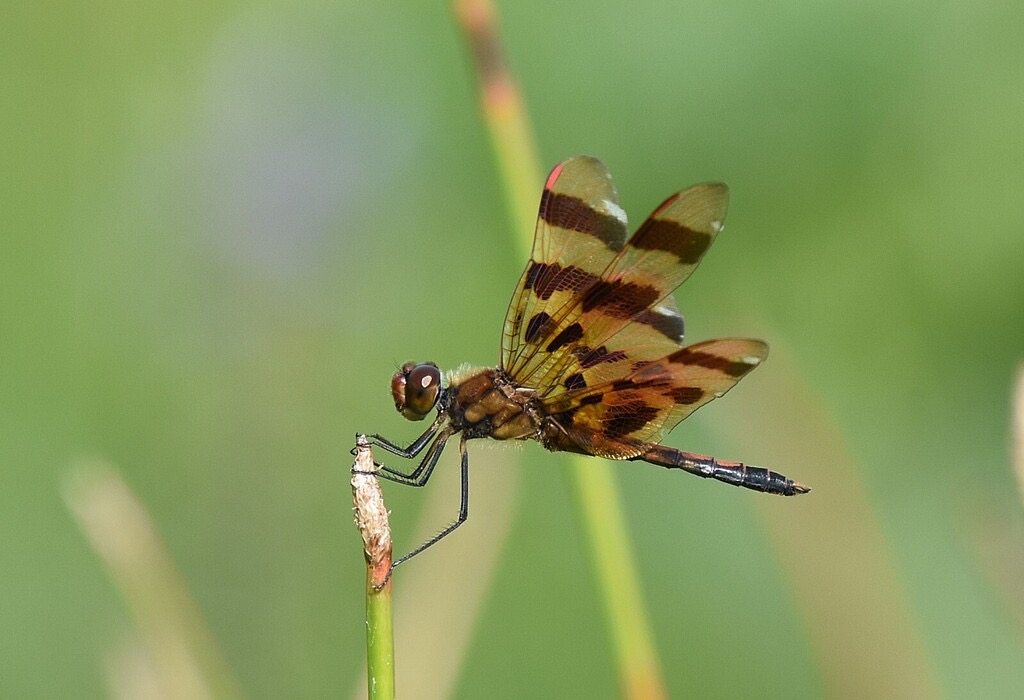
This library is deliberately damselfly-heavy because the historical recovery set centers on dancers, bluets and forktails. Frosted Whiteface and Halloween Pennant are true dragonflies; the other guides cover damselflies, including the broad-winged Smoky Rubyspot.
04 / Field guide
Identification that survives a second look
Begin with body plan, sex and age. Then record face color, thoracic stripes, the pattern on every abdominal segment, wing markings and the terminal appendages. Pruinescence—the powdery coating on mature adults—can hide an underlying pattern, while teneral insects may be pale and soft-colored.
Common names built around blue, violet, red or powder are memorable but not diagnostic. Structural color shifts with angle. Females of many forktails occur in multiple color forms, and several bluet pairs require a close view of male appendages. When a photograph does not show the needed character, leave the record at genus level and explain why.
05 / Field guide
Dancers · Argia
Fourteen stream-associated dancers form the largest group in this collection. Browse them together to compare pruinescence, thoracic pattern, abdominal markings and the verified northern limits of primarily Mexican species.
06 / Field guide
Bluets · Enallagma
Bluets favor ponds, marshes and quiet water, though their ranges and water preferences differ. Male terminal appendages are central to the Boreal–Northern and Hagen's–Marsh identification problems.
07 / Field guide
Forktails · Ischnura
Forktail females often change color as they mature, and several western species overlap. These guides emphasize face color, thoracic stripes, terminal structure and documented range rather than color phase alone.
08 / Field guide
Other pond damselflies
This group brings together six members of Coenagrionidae outside Argia, Enallagma and Ischnura: a tropical range-edge species, a firetail, a California endemic, a spring specialist, a sedge-hidden sprite and a short red seep damselfly.
09 / Field guide
Broad-winged damselflies & skimmers
Smoky Rubyspot is the collection's broad-winged damselfly. Frosted Whiteface and Halloween Pennant are the only true dragonflies here; their verified ranges and habitat differ sharply from one another.
10 / Field guide
A Southwest field routine
Arrive after the site has warmed but before wind and heat dominate. Spend five minutes watching before walking the edge. Patrol routes and favorite perches repeat. Search open water, then emergent stems, low bank vegetation, rock faces and shaded pockets in that order.
Photograph the organism where it is. Do not pull stems, clear vegetation, chill, handle or reposition an insect for a cleaner frame. Springs, seeps and marsh margins deserve the same caution as nests: durable footing and a longer lens are often the responsible choice.
11 / Field guide
Photography without losing the evidence
A close-focusing 100–400mm-class lens gives useful working distance; a macro lens gives more detail where the bank can support a careful approach. Start around 1/500–1/1000 second for a resting insect and increase speed when wind moves the perch. Keep autofocus on the eye, then check whether the thorax and abdominal tip are also sharp.
Make the diagnostic frame first: lateral, dorsal and terminal views as needed. Then work on background, light and gesture. Soft open shade preserves reflective blue and violet, while backlight can reveal wing pattern. Avoid repeated flash at close range and never trade habitat damage for magnification.
12 / Field guide
Records, ethics & uncertainty
Odonata Central and iNaturalist provide complementary evidence. Odonata Central is the specialist record and flight-date resource; iNaturalist exposes photographs, map context and community identifications. The Dragonfly Society checklist anchors current North American names.
A map point is evidence of a documented record, not public-access permission or a promise of present water. Confirm land status, closures and collection rules. For range-edge or difficult species, submit several original-resolution images, precise date and coordinates, habitat notes and a candid confidence level.
Research standard
Sources & field references
- Odonata Central — records, maps and flight data
- Dragonfly Society of the Americas — 2024 North American checklist
- iNaturalist — Odonata observations
Access, fees, closures and regulations can change quickly. Confirm practical details with the managing agency before travel.