02 / Field guide
Identification
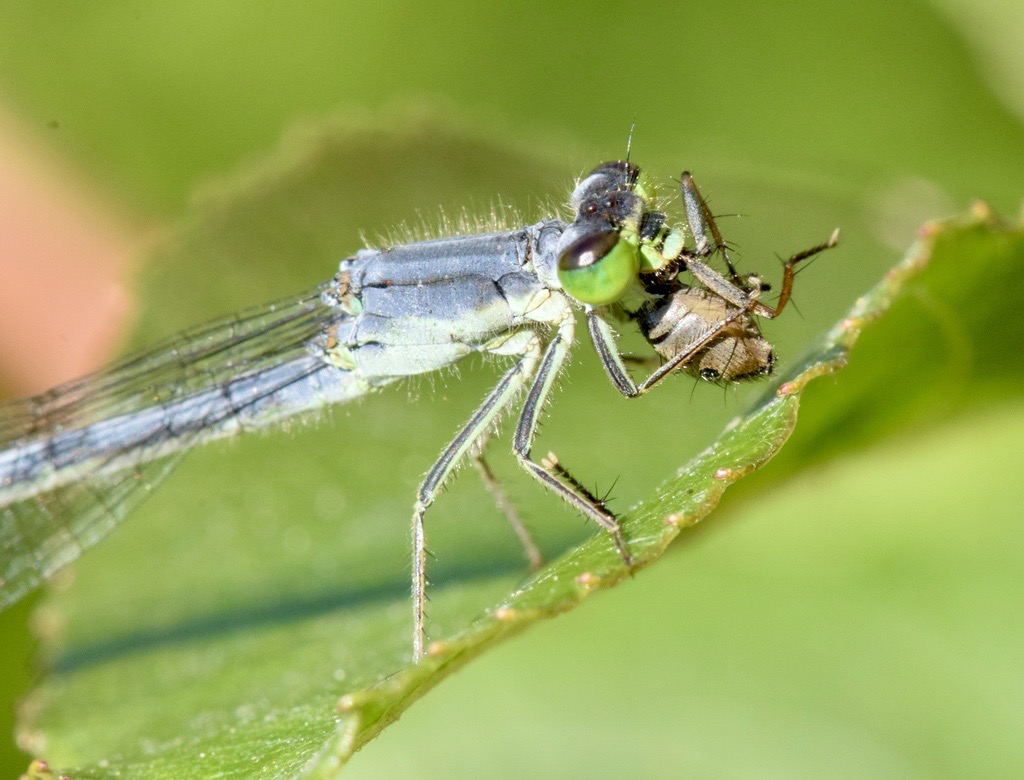
Males have green thoracic stripes and a blue patch near the abdominal tip; young females may be orange before darkening to blue-gray or green.
Males combine green thoracic stripes with blue on abdominal segments eight and nine. Young females are orange, then darken toward green, gray or male-like colors, so age state must be considered before comparison with Plains or Pacific Forktails.
03 / Field guide
Documented range
The checklist restricts Eastern Forktail to eastern North America and gives its range as Saskatchewan, Ontario and Newfoundland south to New Mexico, Arkansas and Georgia.
New Mexico is the explicit southwestern endpoint; Colorado has interior records near the western edge. The page should not imply a broad Arizona, California, Nevada, Texas or Utah distribution.
04 / Field guide
Habitat & flight period
Ponds, marshes, slow streams and vegetated shorelines, frequently in small wetlands and quiet backwaters.
Spring through early fall is typical, with shorter flight periods at cool or high-elevation waters.
05 / Field guide
Finding strategy
Search low shoreline vegetation and photograph face, thorax and terminal segments. Range maps should be checked before assuming a western forktail is this species.
Search low vegetation at ponds, marshes and quiet backwaters within the verified interior range. At western sites, document the face, thorax and terminal abdomen because a familiar eastern identification may be the wrong default.
06 / Field guide
Similar species
Pacific and Plains Forktails are more expected at many western sites. Female color forms are especially unsafe to identify from color alone.
07 / Field guide
Photography in the field
Focus on the eye and use enough depth of field to keep the tiny terminal patch recognizable.
Protect the water edge, keep a working distance, and leave the insect and its perch as found.
Research standard
Sources & field references
- iNaturalist taxon and research observations — Ischnura verticalis
- Odonata Central — North American records, taxonomy and flight data
- Dragonfly Society of the Americas — 2024 North American checklist
Access, fees, closures and regulations can change quickly. Confirm practical details with the managing agency before travel.