02 / Field guide
Identification
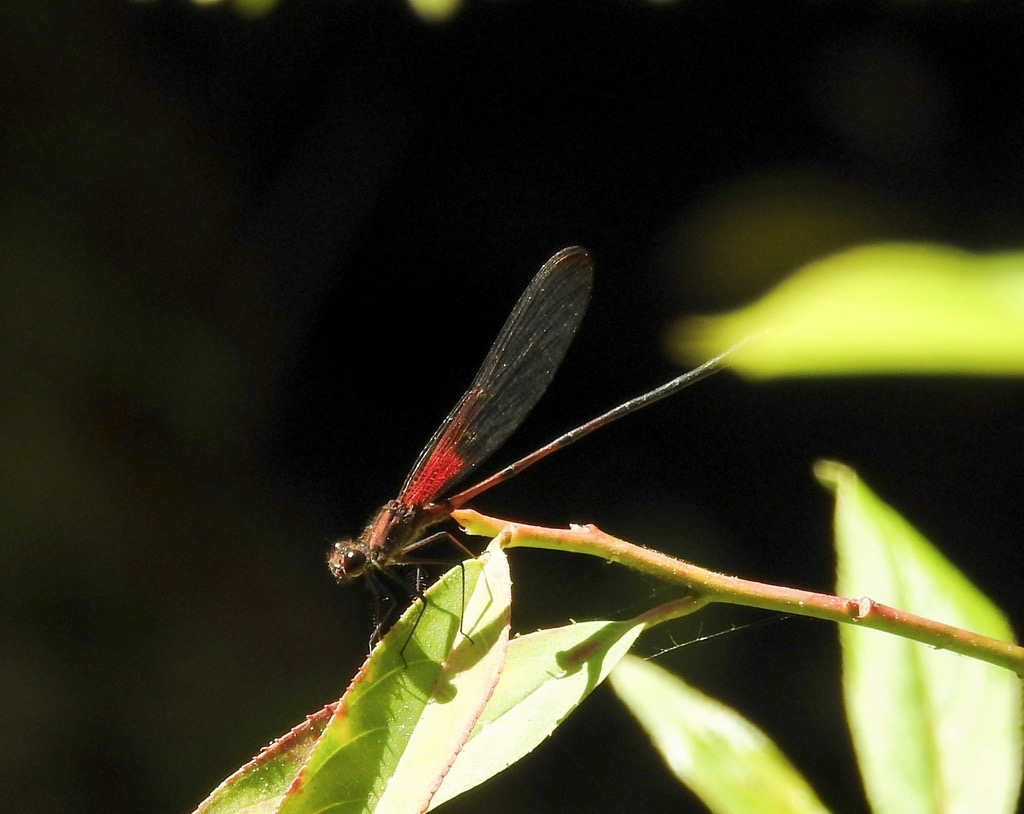
Males have dark smoky wings with a red patch at the base; females have paler patterned wings and lack the male’s saturated basal color.
Males have smoky dark wings with red at the base, while females are paler and lack the saturated male patch. American Rubyspot usually has clearer wings and a more discrete red basal area; variable darkness in overlap zones requires a full-wing photograph.
03 / Field guide
Documented range
The checklist places Smoky Rubyspot from Kansas, Iowa, Wisconsin, Ontario and Pennsylvania south through Texas to Panama and Florida; it specifically says old Arizona records are probably incorrect.
Texas is the supported Southwestern state. Arizona must not be linked or promoted for finding this species, and there is no basis here for a broad 'major Southwestern drainages' claim.
04 / Field guide
Habitat & flight period
Rivers and substantial streams with current, overhanging vegetation and open bank perches.
Warm-season flights predominate, often from late spring into autumn in southern river systems.
05 / Field guide
Finding strategy
Watch territorial males along shaded banks and riffle edges. They frequently return to the same leaf or twig after a fluttering patrol.
Within the verified range, watch territorial males along rivers and substantial streams, especially shaded bank perches beside current. Use Texas or eastern records for trip planning—not old Arizona reports whose validity the checklist rejects.
06 / Field guide
Similar species
American Rubyspot has clearer wings with a more obvious red basal patch. Hybrids and variable wing darkness can complicate overlap zones.
07 / Field guide
Photography in the field
Backlight can reveal the smoky wing texture and ruby base, but check the body exposure and avoid turning the insect into a silhouette.
Protect the water edge, keep a working distance, and leave the insect and its perch as found.
Research standard
Sources & field references
- iNaturalist taxon and research observations — Hetaerina titia
- Odonata Central — North American records, taxonomy and flight data
- Dragonfly Society of the Americas — 2024 North American checklist
Access, fees, closures and regulations can change quickly. Confirm practical details with the managing agency before travel.