_Upper_Huachuca_Canyon_Sierra_Vista_AZ_2018-08-05_11-44-38_(43106620665).jpg)
02 / Field guide
A necessary name change
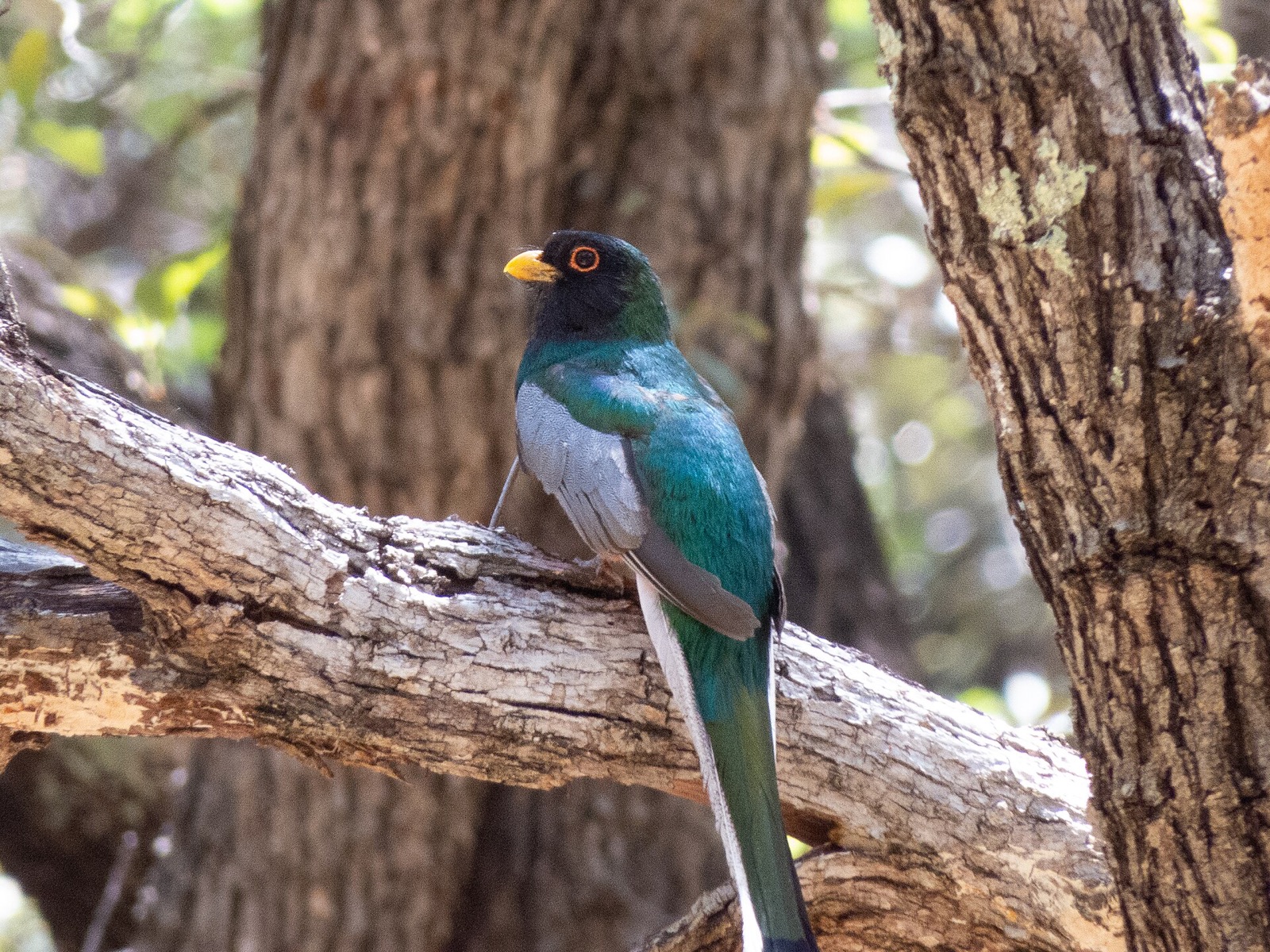
In 2025, ornithologists split the former Elegant Trogon. Birds from Arizona south through much of Mexico are now Coppery-tailed Trogons, Trogon ambiguus. The name Elegant Trogon now applies to populations farther south in Central America. Older field guides, trip reports and search results will often use the previous name.
03 / Field guide
Quick identification
The male combines a metallic green head and upper breast, a crisp white breast band and a red belly. Females are gray-brown above with a muted red belly. Both have the family’s upright posture, short neck, stout bill and long square-ended tail. In dark canopy, shape and voice may register before color.
04 / Field guide
Range & habitat
In the United States, the species breeds regularly only in a small set of southeastern Arizona mountain ranges, with rare reports in southwestern New Mexico. Look in wooded canyons where sycamore-lined riparian strips meet oak and pine. Nesting depends on existing tree cavities, often made earlier by woodpeckers.
05 / Field guide
How to find it
Arrive early and listen for the repeated resonant call. Walk slowly along appropriate canyon habitat, pausing for several minutes at a time. Scan the upper understory and lower canopy, especially horizontal perches and openings where a bird might sally for an insect. Trogons often remain still; constant walking is less effective than deliberate listening and patient scanning.
Most Arizona birds arrive in spring and leave in autumn, although occasional individuals remain in winter. Recent reports can confirm broad presence, but never crowd a calling bird or approach a nest cavity.
06 / Field guide
Where to find it
Madera Canyon in the Santa Rita Mountains and Cave Creek Canyon in the Chiricahuas are established search areas. The Huachuca and Atascosa ranges also support breeding birds. The right habitat and season matter more than a historical pin.
07 / Field guide
Photographing this bird
Expect shade, foliage and a subject that alternates long stillness with abrupt short flights. Begin around 1/500–1/1000 second for a perched bird if stabilization and technique allow; move toward 1/1600–1/2500 for short flights. Use continuous autofocus, a modest tracking area that can hold the bird through branches, and Auto ISO. Expose for the red breast and pale bill without clipping bright patches. Keep distance from calling and nesting birds.
08 / Field guide
Similar species
Eared Quetzal is larger, more crested and differently patterned; it is also extremely rare and irregular in Arizona. Female Coppery-tailed Trogons can appear subdued, but their posture, tail pattern and canyon habitat remain strong clues.
Research standard
Sources & field references
- Cornell Lab — Coppery-tailed Trogon overview
- Cornell Lab — Life history
- Audubon Field Guide — Coppery-tailed Trogon
- Arizona Important Bird Areas — Trogon surveys
Access, fees, closures and regulations can change quickly. Confirm practical details with the managing agency before travel.