02 / Field guide
Quick identification
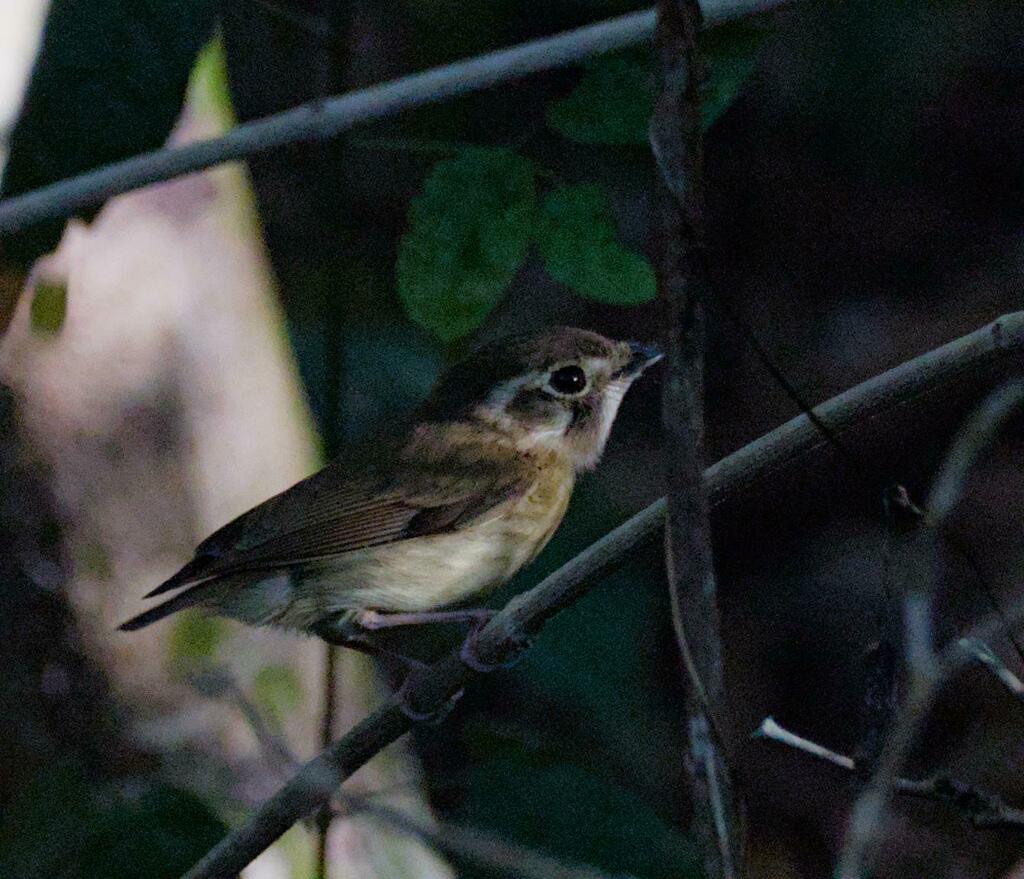
Very small and nearly tailless with a broad flattened bill, bold buff eye ring, olive upperparts and yellowish underparts.
Confirm the whole animal and context rather than a single color patch. Age, sex, molt, distance and light can all change apparent pattern.
03 / Field guide
Range & habitat
Southern Mexico to Costa Rica, principally on the Caribbean slope and adjoining lowlands; U.S. reports would require exceptional documentation.
Humid and semi-humid lowland forest understory, thickets and shaded woodland edges.
Use current observations to confirm broad seasonal presence, then check access with the land manager. A mapped record is not an invitation onto private or restricted ground.
04 / Field guide
Behavior
Perches quietly below the canopy and makes short sallies for insects. Its small size and stillness allow it to disappear inside tangled foliage.
Behavior is useful evidence only when combined with structure and plumage or body pattern. Give the animal enough space to continue feeding, resting or traveling normally.
05 / Field guide
How to find it
Learn the brief sharp call, scan low shaded perches and record habitat and voice. Never treat an old U.S. image path as evidence of present regional occurrence.
Keep the search habitat-led. Recent reports can focus effort, but they should not encourage crowding, trespass or repeated disturbance.
06 / Field guide
Similar species
Golden-crowned Spadebill has a different head pattern; small elaenias and tody-flycatchers have longer tails or different bill and face structure.
When a view is incomplete, record the characters you actually saw and leave room for uncertainty. Photographs, date, location and habitat make later review possible.
07 / Field guide
Photography in the field
Use quiet shutter mode, 1/500–1/1000 second and Auto ISO in deep shade. Keep a clear route out and do not clear understory vegetation around a perch.
Settings are starting points. Subject welfare, legal access and a safe working distance take priority over focal length or frame-filling composition.
Research standard
Sources & field references
- eBird — Stub-tailed Spadebill
- Cornell Birds of the World — Stub-tailed Spadebill
- iNaturalist — Platyrinchus cancrominus
- iNaturalist source photograph taxon — Platyrinchus cancrominus
Access, fees, closures and regulations can change quickly. Confirm practical details with the managing agency before travel.