02 / Field guide
Identification
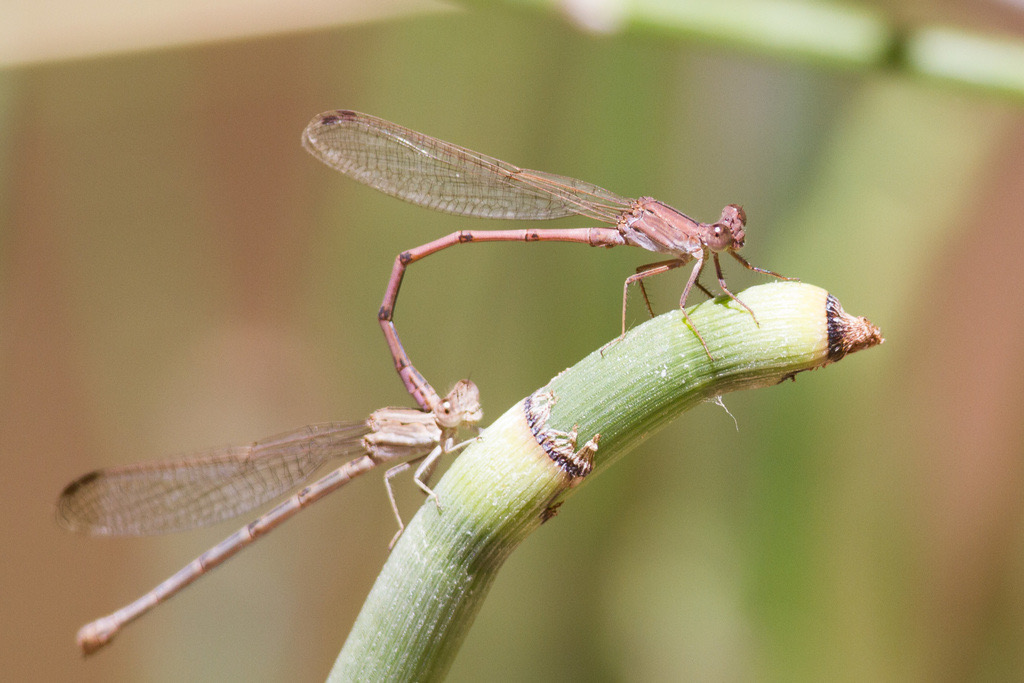
Mature males are pale violet to amethyst with contrasting dark thoracic lines; females and young males are browner and demand attention to the terminal abdominal pattern.
The pale amethyst cast is strongest on mature males and can fade toward gray in flat light. Retain a dorsal thorax view and a lateral image of the abdominal tip; females and young males lack the mature male's clean violet impression and are much easier to confuse with other Argia.
03 / Field guide
Documented range
The 2024 North American checklist places Amethyst Dancer from Arizona and Texas south to Guatemala. It does not list New Mexico, California, Colorado, Nevada or Utah.
In the Southwest, Arizona is the secure western U.S. anchor and Texas supports the eastern edge. Community-platform reports from New Mexico should not be treated as a range extension without specialist validation against current voucher or Odonata Central evidence.
04 / Field guide
Habitat & flight period
Sunny desert streams and spring runs with open banks, scattered emergent plants and reliable water.
Arizona records are concentrated from spring through warm autumn weather, with local timing controlled by water and elevation.
05 / Field guide
Finding strategy
Walk slowly beside flowing water and check low, sunlit perches; dancers often return to a favored twig or cobble after a short patrol.
Start at sunny, permanent desert streams within the verified range, especially open margins that offer low rocks and twigs beside current. Do not use this page as support for a New Mexico search: verify any proposed out-of-range site before travel.
06 / Field guide
Similar species
Aztec, Lavender and other violet-toned dancers overlap locally. Compare thoracic pattern, abdominal markings and male appendages rather than judging hue alone.
07 / Field guide
Photography in the field
Work parallel to the bank so the insect remains against water or shaded vegetation; a low angle reveals the pruinescent color without a busy skyline.
Protect the water edge, keep a working distance, and leave the insect and its perch as found.
Research standard
Sources & field references
- iNaturalist taxon and research observations — Argia pallens
- Odonata Central — North American records, taxonomy and flight data
- Dragonfly Society of the Americas — 2024 North American checklist
Access, fees, closures and regulations can change quickly. Confirm practical details with the managing agency before travel.