02 / Field guide
Identification
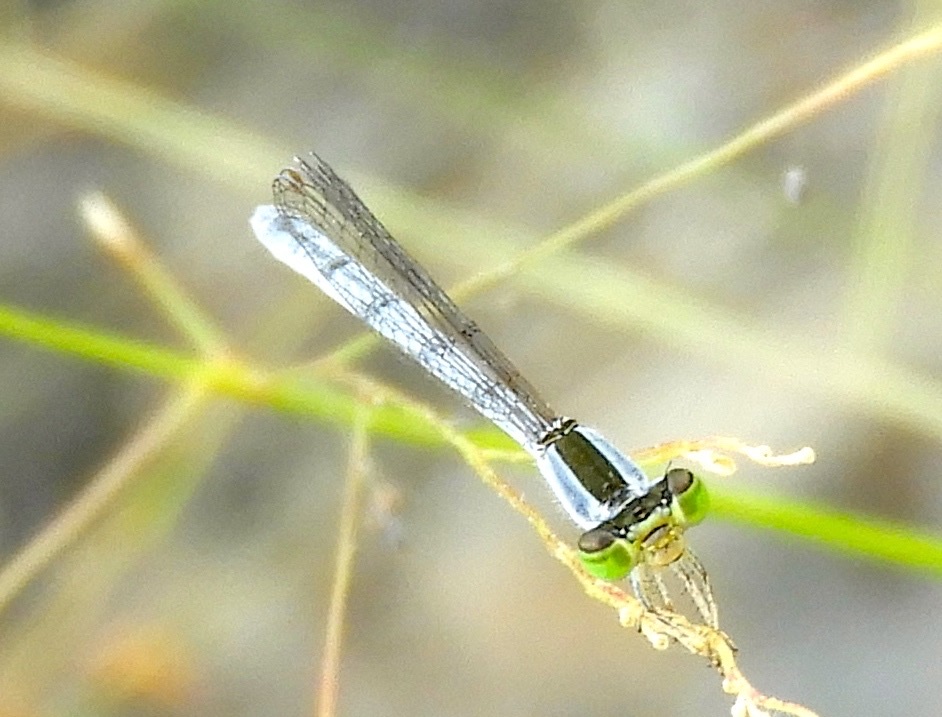
Males are unmistakably tiny and yellow-orange with dark dorsal markings; females are more variable, and mature individuals may be olive or dark.
The adult male's tiny size and largely yellow to orange body are distinctive among regional forktails. Females are less diagnostic and may darken to olive or brown, so retain scale, thoracic pattern and terminal views rather than applying the male's color cue.
03 / Field guide
Documented range
The checklist records Citrine Forktail from California, Nebraska, Wisconsin, Ontario and Maine south through tropical South America, and also on Bermuda, the West Indies, Galápagos and Azores.
Arizona and California hold documented Southwestern populations, with scattered Nevada records; it should not be presented as uniformly distributed across the interior Southwest.
04 / Field guide
Habitat & flight period
Shallow ponds, marshes, wet ditches and slow vegetated waters, sometimes temporary or recently disturbed.
Warm-season flights predominate, and lowland southern populations may persist longer than those at cooler sites.
05 / Field guide
Finding strategy
Search fine grasses immediately beside shallow water. Its minute size makes slow scanning and close-focus binoculars more effective than broad sweeps.
Inspect fine grasses at shallow ponds, wet ditches and marshy margins, especially low in the vegetation. Close-focus binoculars are useful because the insect can disappear below the level at which larger dragonflies are normally scanned.
06 / Field guide
Similar species
Female and immature forktails require care, but the adult male’s combination of tiny size and yellow coloration is distinctive.
07 / Field guide
Photography in the field
Use a macro or telephoto with strong close focus and position the sensor parallel to the abdomen; even slight wind can defeat critical sharpness.
Protect the water edge, keep a working distance, and leave the insect and its perch as found.
Research standard
Sources & field references
- iNaturalist taxon and research observations — Ischnura hastata
- Odonata Central — North American records, taxonomy and flight data
- Dragonfly Society of the Americas — 2024 North American checklist
Access, fees, closures and regulations can change quickly. Confirm practical details with the managing agency before travel.