02 / Field guide
Identification
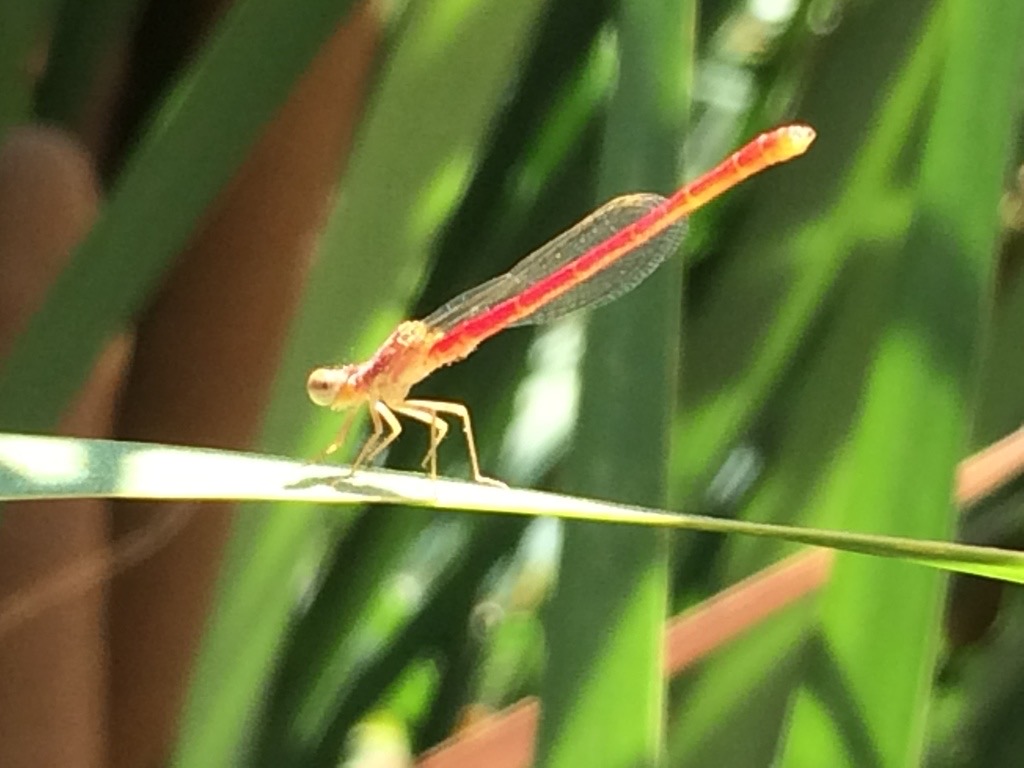
Males are slender red to orange-red with dark markings near the abdominal tip; females are tan, olive or reddish and less conspicuous.
Adult males are slender red to orange-red with dark pattern near the abdominal tip; females are tan, olive or reddish. Body proportions and the placement of dark marks separate it from the stockier Western Red Damsel.
03 / Field guide
Documented range
Desert Firetail ranges from California, Utah and Kansas south to Venezuela on the 2024 checklist, giving it a broad southern and tropical distribution.
It is established through much of the warm Southwest, including Arizona, California, New Mexico, Nevada, Texas and Utah. Local occurrence follows dependable low-elevation water and can be absent from apparently suitable dry-country sites.
04 / Field guide
Habitat & flight period
Warm ponds, marsh channels and slow desert water with dense emergent or floating vegetation.
The flight season is long in hot lowlands, often extending from spring well into autumn when water remains.
05 / Field guide
Finding strategy
Look within rather than above vegetation. Males fly low over quiet margins and often perch horizontally on stems a short distance from the water.
Look within cattails, sedges and floating-edge vegetation rather than above open water. Males fly low through quiet margins and often settle horizontally on a stem where the red abdomen can be seen end to end.
06 / Field guide
Similar species
Large Red Damselfly does not share most of this range; Western Red Damsel is stockier and associated with seepier habitats. Compare body proportions and dark pattern.
07 / Field guide
Photography in the field
Red channels can clip in hard sun. Check the histogram and use soft side light to preserve surface detail.
Protect the water edge, keep a working distance, and leave the insect and its perch as found.
Research standard
Sources & field references
- iNaturalist taxon and research observations — Telebasis salva
- Odonata Central — North American records, taxonomy and flight data
- Dragonfly Society of the Americas — 2024 North American checklist
Access, fees, closures and regulations can change quickly. Confirm practical details with the managing agency before travel.