02 / Field guide
Identification
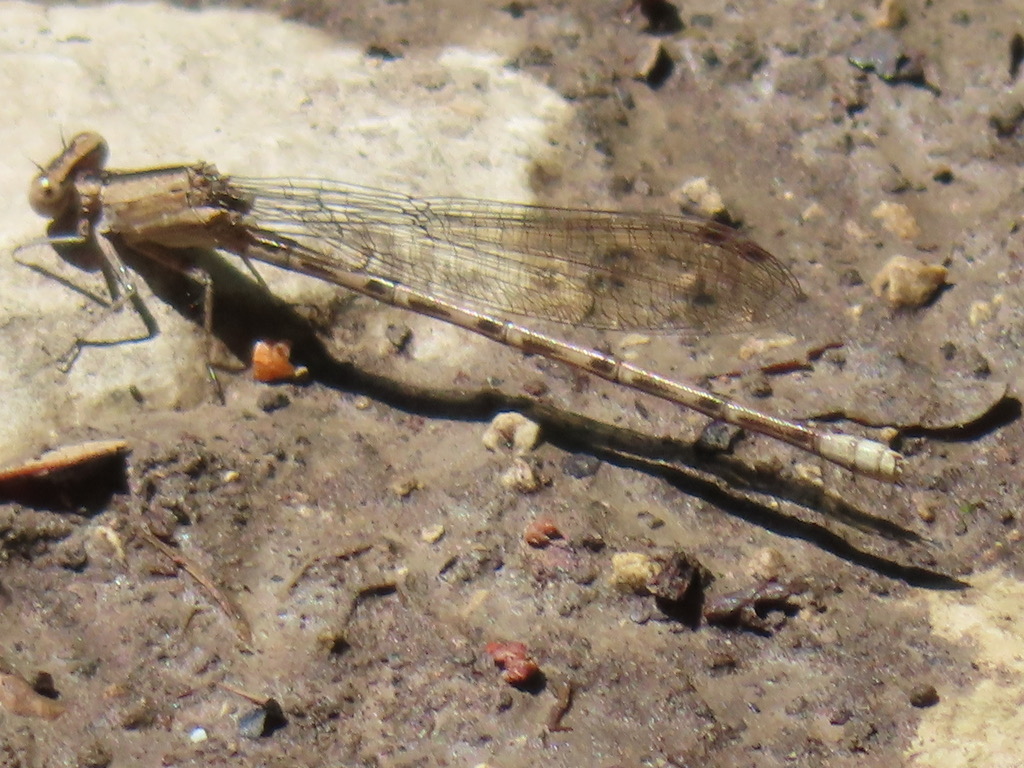
Mature males become powdery blue to lavender with relatively little black, while females and young males retain stronger tan and dark markings.
Mature males become powdery blue to lavender and may conceal much of the underlying dark pattern. Younger males and females expose more tan and black, so record age-related pruinescence and the abdominal tip before comparing Amethyst or Powdered Dancers.
03 / Field guide
Documented range
The checklist gives Kiowa Dancer from California, Nevada and Oklahoma south to Belize, with isolated populations in Montana and South Dakota.
It is supported in Arizona, California, New Mexico, Nevada and Texas; occurrence is tied to dependable streams, rivers and spring runs. Colorado and Utah should be checked against current specialist records rather than assumed.
04 / Field guide
Habitat & flight period
Open streams, rivers, spring runs and irrigation channels, frequently in hot dry country with exposed perches.
Lowland flights often begin in spring and continue through warm autumn weather; upland populations peak later.
05 / Field guide
Finding strategy
Inspect sunlit gravel bars, low branches and debris beside current. Mature males can look almost uniformly pale at a distance, so seek a close patterned view.
Inspect open gravel bars, bridge edges, low branches and debris beside current. Soft morning light preserves the surface texture of a mature male and makes the remaining structural markings easier to retain.
06 / Field guide
Similar species
Powdered and Amethyst Dancers may also become pale with pruinescence. Check the underlying thoracic pattern and terminal abdomen.
07 / Field guide
Photography in the field
Soft morning light retains subtle powdery texture; in midday sun expose carefully so the pale body does not wash out.
Protect the water edge, keep a working distance, and leave the insect and its perch as found.
Research standard
Sources & field references
- iNaturalist taxon and research observations — Argia immunda
- Odonata Central — North American records, taxonomy and flight data
- Dragonfly Society of the Americas — 2024 North American checklist
Access, fees, closures and regulations can change quickly. Confirm practical details with the managing agency before travel.