02 / Field guide
Identification
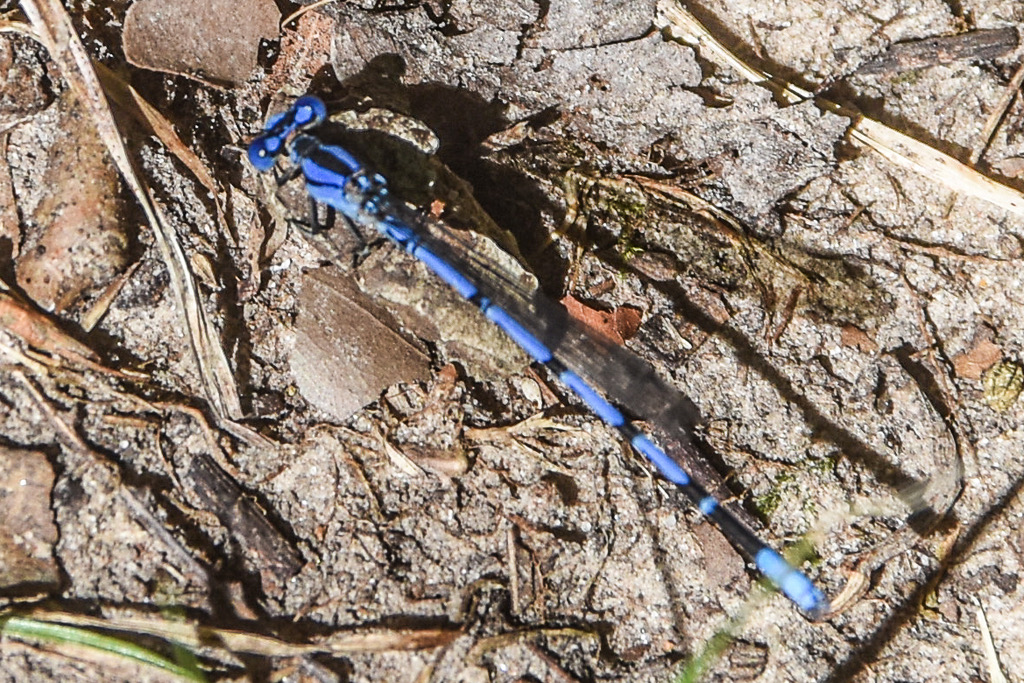
A dark dancer with blue or violet markings; males show a patterned thorax and pale terminal segments rather than uniform body color.
Males are dark with blue or violet thoracic and terminal markings, and mature pruinescence can obscure underlying pattern. Old backlinks and field notes may say Argia plana; current site metadata, schema and search use Argia funebris.
03 / Field guide
Documented range
The 2024 checklist ranges Springwater Dancer from Arizona, South Dakota and Wisconsin south to Honduras, with an isolated Alabama population. It also changes the accepted name from Argia plana to Argia funebris.
Arizona, New Mexico and Texas support the species in the Southwest; occurrence elsewhere should be checked against current specialist records. Isolated spring systems make distribution patchy within the broad outline.
04 / Field guide
Habitat & flight period
Spring-fed streams, seeps and small persistent channels in arid landscapes, frequently where vegetation crowds narrow water.
Adults are associated with warm months, but dependable spring flow can produce local schedules unlike nearby rivers.
05 / Field guide
Finding strategy
Search from durable edges, avoid compressing saturated vegetation, and record the site and full abdominal pattern for any isolated population.
Search spring-fed streams, seeps and small persistent channels from durable ground. The common name points toward habitat, not identity: photograph thoracic pattern and the male tip before separating it from Sooty, Lavender or other local dancers.
06 / Field guide
Similar species
Sooty, Lavender and other dancers may occur in the region. Habitat name is not sufficient—confirm morphology.
07 / Field guide
Photography in the field
Use a long working distance and natural shade; spring habitats are often more vulnerable to foot traffic than the insect is to observation.
Protect the water edge, keep a working distance, and leave the insect and its perch as found.
Research standard
Sources & field references
- iNaturalist taxon and research observations — Argia funebris
- Odonata Central — North American records, taxonomy and flight data
- Dragonfly Society of the Americas — 2024 North American checklist
Access, fees, closures and regulations can change quickly. Confirm practical details with the managing agency before travel.